Chapter: Chapter 57
↓ Transcript
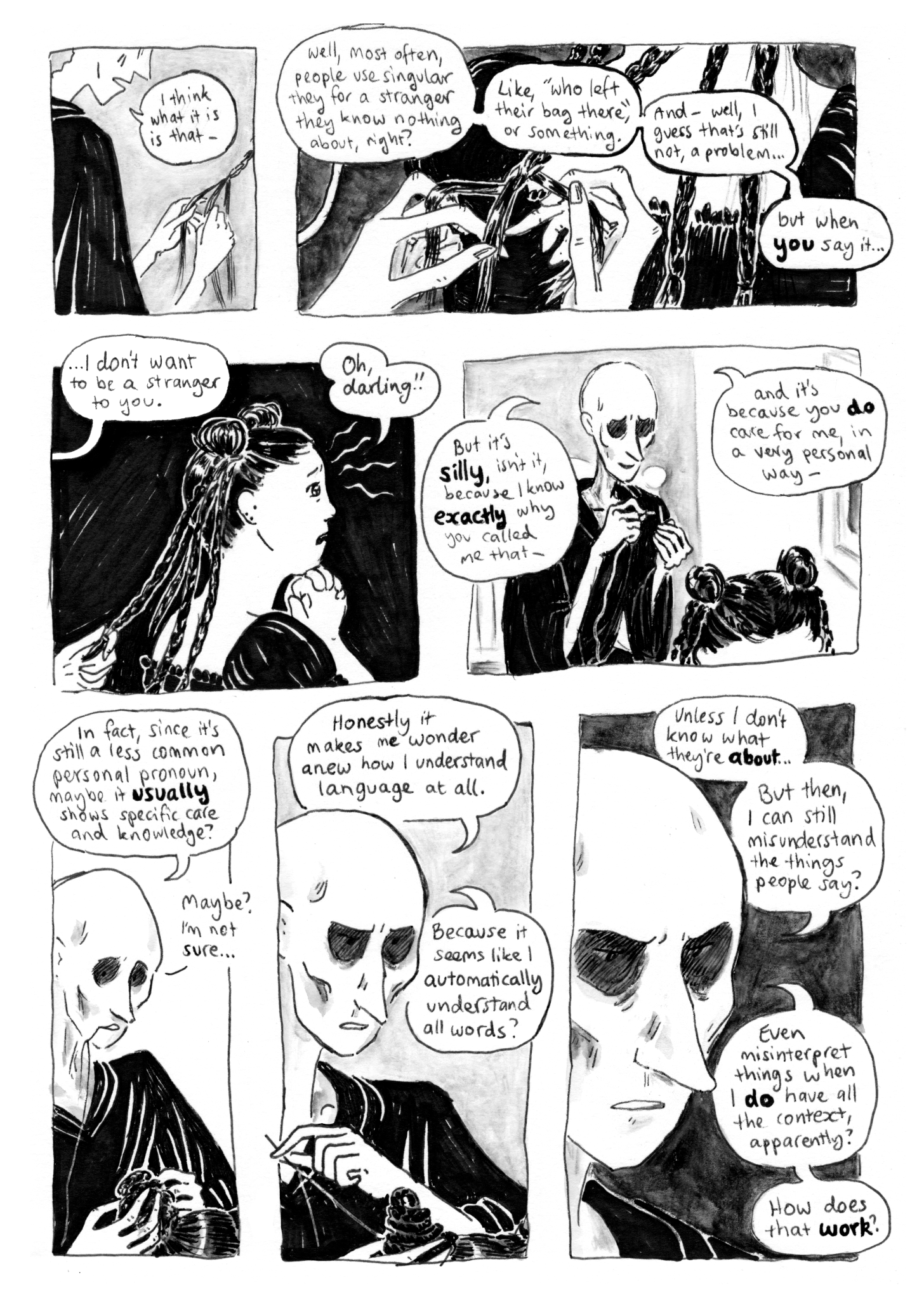
Dee (still plaiting Emily's hair): I think what it is is that - Well, most often, people use singular they for a stranger they know nothing about, right? Like, "who left their bag there", or something. And - well, I guess that's still not, a problem... but when you say it... I don't want to be a stranger to you.
Emily: Oh, darling!!
Dee (having finished all plaits, now threading a needle): But it's silly, isn't it, because I know exactly why you called me that - and it's because you do care for me, in a very personal way -
Dee (needle in corner of mouth, coiling Emily's plaits around her buns): In fact, since it's still a less common personal pronoun, maybe it usually shows specific care and knowledge? Maybe? I'm not sure...
Dee (sewing the coiled plaits into a cone shape): Honestly it makes me wonder anew how I understand language at all. Because it seems like I automatically understand all words? Unless I don't know what they're about... but then, I can still misunderstand the things people say? Even misinterpret things when I do have all the context, apparently? How does that work?
---
Alt text: magic powers to know the possible senses of a word but not necessarily the sense in which it's currently being used? i feel the possibility of miscommunication is central to the ability to communicate but maybe that's just me
Emily: Oh, darling!!
Dee (having finished all plaits, now threading a needle): But it's silly, isn't it, because I know exactly why you called me that - and it's because you do care for me, in a very personal way -
Dee (needle in corner of mouth, coiling Emily's plaits around her buns): In fact, since it's still a less common personal pronoun, maybe it usually shows specific care and knowledge? Maybe? I'm not sure...
Dee (sewing the coiled plaits into a cone shape): Honestly it makes me wonder anew how I understand language at all. Because it seems like I automatically understand all words? Unless I don't know what they're about... but then, I can still misunderstand the things people say? Even misinterpret things when I do have all the context, apparently? How does that work?
---
Alt text: magic powers to know the possible senses of a word but not necessarily the sense in which it's currently being used? i feel the possibility of miscommunication is central to the ability to communicate but maybe that's just me